Showing posts with label Mystery. Show all posts

Wednesday, August 14, 2013

Hidden Treasures - 6

The Amber Room
The people, who saw it before it was lost, called it the eighth wonder of the world. We̢۪re talking about a three square meters room with four beautifully sculpted amber panels as walls, gold-frame mirrors and four Florentine mosaics. The amber was studded with jewels and the room itself housed one of the most beautiful collections of Russian and Prussian art. It was created for King Frederic I of Prussia, but was given to Peter the Great of Russia, as a gift.

A replica of the amber room is on display at Catherine Palace, in Russia.

During World War II, when Hitler attacked Saint Petersburg, the Russians tried to move the amber room, but the walls were cracking, so they decided to cover it with wallpaper. Unfortunately, they failed and the Nazis found the prized treasure and took it with them to Konigsberg Castle, where it remained until the end of the war.

When Konigsberg Castle was inspected, the room was nowhere to be found. Some say the Russians destroyed the amber room when they bombarded the castle or when Konigsberg burned, soon after it surrendered, while others say that it is buried in a bunker somewhere.

The Ark of the Covenant

To the old Israelis, the Ark of the Covenant was the most sacred thing on Earth. It was said the precious chest was created by God himself, from acacia wood, plated with pure gold. The chest featured a lid with two gold cherubim looking at each other. It contained many holy relics, including the stone tablets with the Ten Commandments.

The Ark of the Covenant was housed in the Temple of Solomon, in Jerusalem, the capital of Judea. In the year 600 BC, the city was attacked and conquered by the Babylonians, after a conflict that claimed the lives of over one million people. 17 years later, when the Israelis reclaimed Jerusalem, the Ark of the Covenant was gone. The Babylonians may have destroyed the priceless artifact, but some believe it was taken by God, for protection.

The Treasure of the Pharaohs

When the tomb of Tutankhamen was discovered, in 1922, archeologists were amazed by the riches buried with the pharaoh. It took scientists years to examine all the jewels, but when they discovered all the other tombs in the Valley of the Kings, they realized they were all empty. Grave-robbers surely worked their magic on the burial places, before archeologists discovered them, but it would be impossible for a few petty thieves to transport all those riches.

Some historians believe the pharaohs̢۪ tombs were raided during the twelfth Egyptian dynasty, when a certain Heribor was in charge of re-burials, during which time he had the opportunity to take whatever he wanted from the tombs. Many believe that when Heribor̢۪s burial place will finally be unearthed, the lost treasures of the pharaohs will finally be revealed.


Hidden Treasures - 4

Blackbeard’s Treasure
Not to be confused with the Blackbeard known as Edward Teach, Captain Blackbeard’s treasure of pure Spanish Silver Bars was worth 1.5 million dollars back in 1811. Now that may not seem like a lot, but with the price of silver these days, Blackbeard’s treasure could be one of the biggest bootys still waiting to be found.

Back in 1811 Captain Blackbeard was commissioned from the British Admiralty to raise the wreckage of a Spanish galleon that had gone down off the Bahamas during a Hurricane in 1680. He was successful by towing the ship into Baltimore with all the loot intact.

Of Course this called for a Celebration, the likes of which brought justice to the song “Drunken Sailor.” During his drunken rant he was approached by a profiteer at the tavern who told him that he knew all about his precious silver, and had the means to alleviate Blackbeard’s burden of sending it back to England.  Between this and the upcoming war between Britain and the U.S. Captain Blackbeard decided to stash the silver.

Sometime near the end of the summer of 1812, Blackbeard made a trip to the village of Keating Summit, McKean County Pennsylvania. It would be here that he would bury some or perhaps all of the Silver, with the idea of digging it up later.

Unfortunately, he sent someone else to retrieve it, and they were never able to locate it….At least so they claim.


King John’s Crown Jewels
In the year 1215 a caravan of King John of England made an unsuccessful attempt to cross the sands of The Wash, while on its journey between Kings Lynn and Long Sutton. During the escapade, the treasure loaded caravan was trapped by an incoming tide and descending current from the Nene River.

King John had taken a different path due to his illness, and was able to witness the loss of the treasure first hand. The treasure was said to contain his most prized possession, the Crown Jewels. Luckily however, he died a few days later, so the loss of his crown Jewels probably didn’t burden him very much.

The Present Day location of the treasure (or rather the loss of) is considered to be somewhere near Sutton Bridge, on the River Nene, if you want to go looking.

Tuesday, August 13, 2013

Hidden Treasures - 5

The Treasure of Moctezuma
For those of you who have heard of Motezumas revenge, you may also have heard the story behind why someone might be seeking revenge from beyond the grave.

In 1519 an armada of Spanish troops set sights on Mexico after hearing the legendary stories of “El Dorado” the City of Gold. Now, semi ironically, they did find a mountain of silver when they landed (yes a real mountain), however, as interesting as finding a mountain made of silver may be, this story is about treasure that “Hasn’t” been found yet.

Now for those of you who have read our article about prophecy, you may be familiar with what happened when Cortes arrived. As luck would have it, his arrival fulfilled the Aztec prophecy that the wind god Quetzalcoatl would return to reclaim Mexico. Since their wasn’t anyone else around to challenge his identity of being the wind god, Cortes assumed the role and essentially took everything they had, raping and pillaging and on his way out he left the Aztec people with a few new diseases to try out and experience.

So as you can see, this might make a soul a little restless.

Okay, so there was a bunch of gold and a mountain of silver. Where can I find it.

According to some, in 1920 Freddy Crystal found a treasure map inside a long forgotten manuscript that was stored away in an old church. The manuscript was written by a Spanish Friar who stated that the Spanish had tried to follow the map, but were unfamiliar with the territories to the north and eventually gave up in frustration.

Crystal had learned how to decipher Aztec petroglyphs from canyon walls, and realized that some of the landmarks were similar to those found in Southern Utah, particularly one place near the town of Kanab.

Crystal showed his map to a wealthy rancher named Oscar Robinson and convinced him to invest in his treasure hunt. After 2 years of searching, he actually found a location that fit the map. A large main canyon with side draws, seven mountains, each in it’s proper order!

Excited, he ran down the mountain side to the site where he found steps that were carved directly into the mountain. After climbing the steps he came to a “False Wall” in the cliff face, that led to a long dark corridor. On both sides of the corridor were statues that appeared to be ancient in their origin.

At this point he told everyone in the town and got hundreds of them all excited and volunteering to help out with the excavation of the long lost treasure of Moctezuma. After three years, the residents found lots of false walls and exposed an entire cave system, some of which can still be explored today. Which means you may still have a chance to find the treasure, assuming of course your with someone who knows how to find the hidden entrance.

Hidden Treasures - 3

White City, La Ciudad Blanca
A rumored city of gold has been the fascination of many for some time. Herman Cortes stumbled upon it in 1526, then Cristobol de Pedraza in 1544. Archeologist William Strong noted ‘archeological mounds’ near Rio Patuca and Rio Conquirre in 1933, providing more fuel for a growing legend where “nobles there ate from plates of gold.” As recently as February this year, archeologists and other researchers from the National Science Foundation and the University of Houston have used advanced technology such as mapping light detection and Light detection and Ranging (LIDaR) to map the ancient ruins. The verdict is still out if this area holds treasures of gold.

Lue Treasure Map

The only legendary treasure to have a map that directs you to 14 tons of gold is the Lue. As mystifying as the code is, it has long been assumed the only tools needed to decode the Lue is a one dollar bill, a key and a sound understanding of Masonic symbolism. Published by Karl Von Mueller, some speculate the “map” consists of various mathematical formulas.Believed to be in the United States, the legend of the Lue claims the treasure is 14 tons of gold. The gold was brought to the US by the Nazis in a plan to sabotage the US economy and prevent Americans from entering World War II. After hearing the plan, the Gold Act was instituted to circumvent the Nazis’ plan. Failing to prevent the US from entering the war wasn’t the only failure in Nazis’ grand scheme. They also failed to decipher the Lue and the Nazi loyalist that created had died. Ultimately they were unable to retrieve the treasure and returned to Germany.

Treasure Chest of the Church of Pisco
Four soldiers of the Peruvian Army in the mid-1800s devised a plan to outwit priests after learning about their treasures. Luke Barrett, Arthur Brown, Jack Killorain and Diego Alvarez, gained the confidence of the Pisco Church in Peru and managed to sail away with over 14 tons of gold and other treasures after killing the priests. Unfamiliar with the area, the four drew a map, ditched the loot and headed to Australia; with the hope of eventually returning and recovering their booty. Unfortunately, prior to returning for their treasure, two were killed and the other two were arrested. Only Killorain survived the jail stint. Before he died he told Charles Howe about the Pisco Church heist and where the treasure was stashed. When Howe found the treasure, he was not equipped to move the treasure. He left the treasure hoping to return and collect. Out of money, Howe failed to return to collect the treasure but he had disclosed the location to George Hamilton who eventually went looking for the treasure but never found it because he couldn’t understand the map.

Yamashita’s Treasure at Bacuit Bay
In Palawan, Philippines, Bacuit Bay is an island that on its own should be considered a treasure. Bacuit Bay is small, yet boasts a legendary story about Tomoyuki Yamashita’s lost treasures. A decorated general for the Japanese Army, it is speculated that Yamashita hid treasure in the caves of Bacuit Bay in the 1940s. Yamashita obtained his treasures by looting many bordering countries during the 30s until World War II. Yamashita’s treasures includes loot from Malaysia, India, Thailand and Burma, which were all shipped to the Philippines prior to their final destination—Japan. Unfortunately for Yamashita, Japan surrendered while he was still in the Philippines. Prior to being captured and hung, Yamashita hid his treasure in 172 different places on the island. He and his crew assumed they would eventually come back for the treasure. Some sources estimate that Yamashita’s treasures could be worth billions today. In the 70s, Rogelio Roxas found part of the treasure. Unfortunately President Ferdinand Marcos confiscated his findings and the remaining treasure located in that particular tunnel. Roxas sued and was awarded $22 billion dollars. Although the Marcos and Roxas family continue to battle in court, based on the story, there are more caves filled with Yamashita’s other treasures.


Hidden Treasures - 2

Lost Adams Diggings
To find a canyon wall that cries tears of gold you will need to map yourself a route to the Lost Adams Diggings in western New Mexico. It was in the early 1860s when Adams made his trek to the area. Guided along the White River and into the White Mountains, Adams and his crew of miners found gold nuggets that hidden “in a corn-grinding basin.” Although Adams left the mine on the second night, the miners stayed when they were brutally attacked and killed by Apache Indians. Tales say that Adams was never able to find his gold canyon again.

Apache Indian Treasures


There is an abundance of real lost treasures, some of which belonged to the Apache Indians. Rumor has it that after attacking a wagon train the Apache Indians hid their stolen fortune of silver coins and gold dust in a Dutch oven. This oven, which contains the lost treasure, is hidden behind rocks at a point on Winchester Mountain in Arizona. Those in search of the treasure claim the point is cursed but that has not stopped treasure hunters from trying their luck.

Lost treasures of Antilla

Those seeking the lost treasures of Antilla, the German fighter wreckage, will need to dive along the North Point of Aruba. There’s a tale that claims the Antilla was anchored along the North Shore when authorities rowed out to sea and asked for its surrender. While the skipper contemplated his options on shore, he left the ship’s seacock open, this sank the ship. Instead of surrendering and losing his treasure, the ship exploded and sank. This ghost ship, as the locals call it, remains a tribute to the German soldiers from WWII.

SS Islander’s Evasive Gold
In a bit of irony the SS Islander that sank in 1901 was recovered in 2012-without any gold. Why is it on the list? Well the Mars Company, the expedition, crew thinks the gold may be on the sea bed as a result of moving the ship. They did find gold dust and pieces of gold on the recovered ship but that’s about it. Mars Company estimates the treasure will be valued at over $250 million therefore they are planning another expedition. You can see part of the ship on the banks of Admiral Island while the rest is in Seattle.


Monday, August 12, 2013

The Sixth Sense

We are equipped with five senses, which acquire the knowledge of the “material” world for us and make us aware of the physical aspects of the world. The arguments between matter and spirit is known as spiritual war which we know as battle of Mahabharata.

The reason is, we are not only unaware of the sixth sense but also humiliate it now and then. Say, we are deprived of all five senses right from our birth, we are still aware of our self. The sense which makes us aware of our SELF is known as common sense or sixth sense, or KARNA in Mahabharata, who is humiliated by the 5 senses the Pandavas.

Therefore, a Spiritual war(of arguments) has to be arranged on the battlefield of KURU-KSHETRA(karmabhoomi/Body) to win the royal Kingdom of GOD, Indraprastha. The weapon to be used is LOGIC, which is as sharp as an arrow.

The situation in this war is more complex as the sixth sense the KARNA(which is capable of listening to inner voiceantahkarna favours KAURAVAS(material aspect of the universe), so the PAARTH(Learner) has to lift his bow, the gandeev (secven chakras) and should listen to his inner voice of the SELF (KRISHNA) to win the battle !

Hence , PAARTH is the first SIKH(shishya/disciple) of the Hindu philosphy as he is the one who is going to learn. Modern Sikhs Gurus live in Birmingham and Toronto, I reckon !

Similarly, SACH and SATT are two entirely different entities, which compliment each other in that SACH is the key to SATT. SACH is what one's five sensory organs detect and SATT is known through the Third eye of logical reasoning. In other words what you see with the two naked eyes, TANN DIAN DO AKHANH, is true, SACH and what you seek through reasoning, VICHAAR, with the help of the third eye of awakened mind, MUNN DI TEEJI AKH called SURTTI, or COMMON SENSE or Sixth Sense is SATT. SACH is DHAEKHNAA(seen) and SATT is PAEKHNAA(perceived)

Hidden Treasures -1

Santissima Concepcion
Hurricane season in Florida has led to many shipwrecks throughout history. One notable shipwreck that fell prey to the tumultuous southern hurricane season was the shipwreck of Santissima Concepcion or “El Grande.” The record listed 500 people on board, but various reports have identified anywhere between 4 to 190 people who survived to describe their ordeal. Beyond the crew the record also lists 1,800,000 pesos in treasures, “77 chests of pearls and 49 chests of emeralds.” There have been numerous attempts to locate the treasure yet most have proved fruitless. It is believed the Sir William Phipp found about 25% of the treasure during his 1687 expedition.


Genghis Khan Issyk-Kul’s Treasure
There are a variety of legends surrounding Lake Issyk-Kul. From the idea that Templar Knights and Christians buried treasures of the Templar there to lost jewels forming a golden path, many legends persist about the area. One of the most notable legends is of Commander Genghis who is supposedly buried with his treasures. Some legends have his treasure in the lake and others admit the location is unknown. Reports indicate that his soldiers killed everyone that knew the tomb’s location and when they returned from the burial site, they were killed as well.Commander Genghis amassed his fortune by “capturing most of central Asia and China,” in the 13-century, of which “the booty yielded by his conquests was incalculable.” Digs in the ’20s failed due to the instability of the political environment. Since then there have been more attempts including expeditions by the Japanese and a recent attempt by American researchers who believe they have located Genghis Khan’s tomb, but there is no treasure to date.

Bermuda Triangle

Long before the legend of the Bermuda Triangle became popular, Bermuda had already earned a reputation as an enchanted island. It was nicknamed “The Devil's Islands” by early sea travelers, frightened by the calls of cahow birds and the squeals of wild pigs that could be heard on shore. But perhaps the most damning tales were told by sailors terrified of shipwreck on Bermuda's treacherous stretch of reefs.

The legend of the Bermuda Triangle is said to have begun when five Navy planes took off from their base in Florida December 5, 1945 on a routine training mission known as Flight 19 – neither the planes nor the crew were ever seen again.

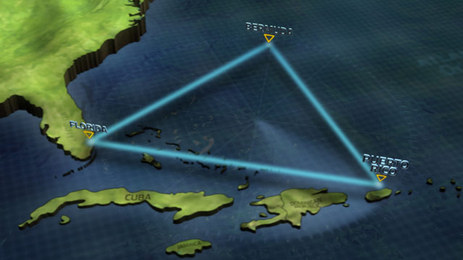
The imaginary area referred to as the Bermuda Triangle covers about 500,000 square miles of ocean off the southeastern tip of Florida; an area roughly bounded by Miami, Bermuda, and Puerto Rico. This region didn't get its name until August 1964 when Vincent Gaddis coined the term Bermuda Triangle in a cover story for Argosy magazine about the disappearance of Flight 19.

Unusual features of the area had been noted since Christopher Columbus sailed through the area on his first voyage to the New World, in which he reported a great flame of fire (probably a meteor) crashed into the sea one night and that a strange light appeared in the distance a few weeks later. He also wrote about inconsistent compass readings, which later believed as natural phenomena happens in places where True North (geodetics’ north pointing to the North Pole’s geographic location) and Magnetic North (well-known as Compass North) lined up – the two north are in fact have different scientific implications.
In the past 500 years at least 50 ships and 20 aircraft have reportedly vanished in the Triangle, most without a trace – no wreckage, no bodies, nothing. There have also been so many theories trying to explain the legend, including one suggesting that the lost city of Atlantis may lie at the bottom of the sea and be using its reputed crystal energies to sink ships and planes.

But, despite all the reports by authors around the globe regarding the untraceable missing planes and ships, is there really any mystery to explain?

Not all apparently believe there are mysteries to explain. Lieutenant A. L. Russell, in the U.S. Coast Guard's official response to Bermuda Triangle inquiries, writes “It has been our experience that the combined forces of nature and the unpredictability of mankind outdo science-fiction stories many times each year.” In the Navy's final report, the disappearance of Flight 19 was blamed on pilot error, but after several reviews the verdict was changed to causes or reasons unknown.

“The region is highly traveled and has been a busy crossroads since the early days of European exploration,” said John Reilly, a historian with the U.S. Naval Historical Foundation. “To say quite a few ships and airplanes have gone down there is like saying there are an awful lot of car accidents on the New Jersey Turnpike—surprise, surprise.”

Maritime insurance leader Lloyd’s of London does not recognize the Bermuda Triangle as an especially hazardous place and neither does the U.S. Coast Guard who says “In a review of many aircraft and vessel losses in the area over the years, there has been nothing discovered that would indicate that casualties were the result of anything other than physical causes. No extraordinary factors have ever been identified.”
In his book “The Bermuda Triangle Mystery — Solved”, American author and pilot Larry Kusche says few writers on the topic bothered to do any real investigation — they mostly collected and repeated other, earlier writers who did the same. Criticizing Charles Berlitz’s “Bermuda Triangle: The Bestselling Saga of Unexplained Mystery”, he says the book does not carry over into credible research or scholarship, and that Berlitz's research was so sloppy. “If Berlitz were to report that a boat were red, the chance of it being some other color is almost a certainty.”

Kusche claimed to have examined more than 400 pages of the Navy Board’s official investigation report regarding the disappearance of Navy planes in 1945, and found that the Board wasn't baffled at all by the incident and did not mention alleged radio transmissions cited by Berlitz in his book
About the lined up of True North and Compass North, the US Navy says that’s been an inaccurate claimed. According to him the Bermuda Triangle is not a place on earth at which a magnetic compass points towards true north. Normally a compass will point toward magnetic north. He explains the difference between the two is known as compass variation. The amount of variation changes by as much as 60 degrees at various locations around the World. If this compass variation or error is not compensated for, navigators can find themselves far off course and in deep trouble.

“Although in the past this compass variation did affect the Bermuda Triangle, due to fluctuations in the Earth's magnetic field this has apparently not been the case since the nineteenth century,” he concludes.
Fact or fiction, the Bermuda Triangle has already been accepted as a part of widespread lore that won't disappear anytime soon. There are still many travelers saying the Triangle isn't the only thing that makes The Islands of Bermuda seem magical.